Tuesday, January 24, 2017

1o. relatório semanal MSM60 - 1st weekly report MSM60


Tudo vai bem no Atlântico, agora estamos mais próximos da América do Sul que da África. O ritmo de trabalho é intenso, mas está funcionando bem.

O cruzeiro MSM60 faz parte de uma iniciativa do projeto europeu AtlantOS e do programa POGO, como já havia comentado antes. Com a malha amostral densa, o cruzeiro tenta fazer um painel sinótico da circulação e biogeoquímica do Atlântico Sul de leste a oeste, na latitude 34.5S. Além disso há uma componente de capacitação bem forte, com participação de alunos de doutorado e cientistas de 8 países diferentes (Alemanha, França, Argentina, Itália, Brasil, Suécia, África do Sul e Inglaterra), e maioria feminina absoluta! Anteriormente, haviam sido realizados outros cruzeiros, mas limitados às bacias leste e oeste nesta latitude.
Para dar uma ideia melhor das atividades a bordo, sugiro a leitura do relatório semanal (1a semana, outros virão - escolha seu idioma e clique para baixar o pdf) do cruzeiro:
---------------------------------------------------------------------------------------------
Everything is fine in the Atlantic. We're now closer to South America than Africa, and working a lot!

MSM60 is part of a joint initiative from EU-project AtlantOS and POGO, as I've commented before. The goal is to have a synoptic picture of the whole section along latitude 34.5 S, and of course it has a strong capacity building component. We're scientists and students from 8 countries (Germany, France, Argentina, Italy, Brazil, Sweden, South Africa and England), and mainly women scientists! There have been quite a few former cruises along the 34.5S latitude, but they were restricted to either eastern or western basins.
To give you a better idea of our life on board, check out the first weekly report (the following ones will arrive soon). Just click on your favourite language to download the pdf:
English  -  German  -  Portuguese  -  French  -  Spanish

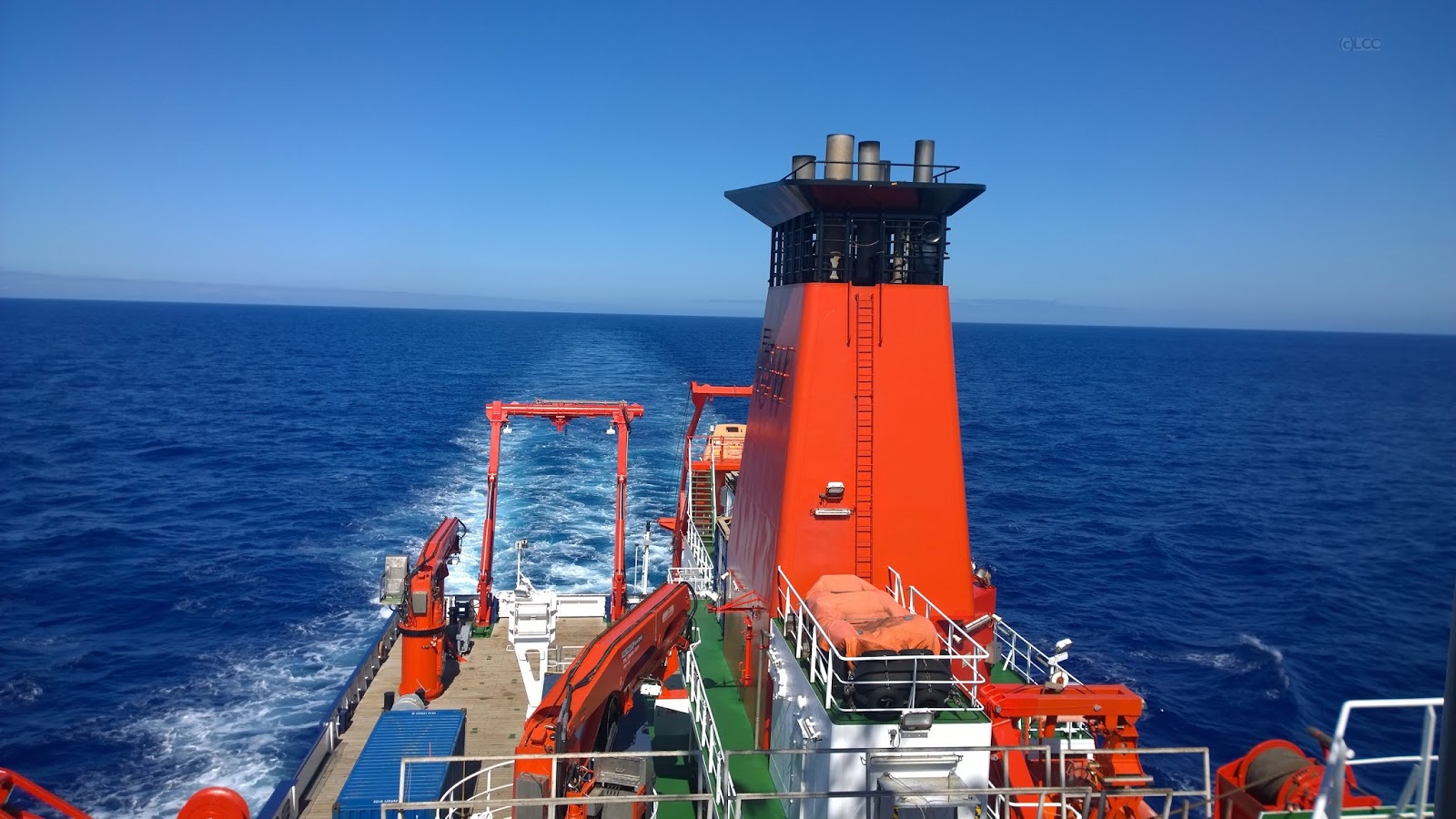
Stern view from the bridge

Happy selfie - #quemédomarnaoenjoa

Friday, January 13, 2017

Um SOS diferente - A different type of SOS

Hoje pedirei licença, mas preciso sair do tema Oceanografia para falar da instituição na qual eu trabalho, a UERJ. Para os cidadãos fluminenses, acho que nao é preciso explicar muito. Para os outros, de fora, trata-se de uma das melhores universidades públicas do país, e que existe há 64 anos.

Pois bem, o estado do Rio de Janeiro enfrenta uma crise financeira sem precedentes, e nao vou entrar em detalhes aqui nos reais motivos desta crise.

O fato é que os funcionários da universidade e seus bolsistas estão sem receber seu salário desde novembro. Falta ainda uma parcela de novembro, dezembro, e o décimo terceiro. Isso vale também para muitos outros funcionários e pensionistas do estado. Como se não bastasse, o governo do estado não paga há vários meses o custeio da instituição, isto é, contas de água, luz, telefone, gás, etc. Esta situação pode levar ao fechamento total da Universidade. Vamos refletir um pouco e pensar no que isso pode significar. Mais de 30000 alunos, mais de 2500 docentes - ativos em projetos de pesquisa, inovação tecnológica e extensão. Vários cursos de graduação e pós-graduação da UERJ estão entre os melhores do país. Como imaginar que isso tudo seja perdido? Sem contar o patrimônio material (construído com dinheiro público - seu, meu, nosso - diga-se de passagem) jogado fora (equipamentos de pesquisa e ensino).

Daqui do meio do Atlântico, minha esperança se junta à de todos os meus colegas e alunos.
  #souuerj  #uerjresiste 
----------------------------------------
Today I'll quickly change subject, and I'll write about the University where I work - Universidade do Estado do Rio de Janeiro (UERJ - Rio de Janeiro State University). For many Fluminense and Brazilian citizens, I don't need to explain much. For the people abroad, UERJ is one of the best public universities in Brazil, and probably also well-ranked in South America. It exists since 64 years now, and is directly attached to the Rio de Janeiro State Government.

Well, the federal state of Rio de Janeiro is going through its worse financial crisis ever, and this since 2015. I'm not going to give details about the true reasons of this financial crisis, unless I change from Oceanography to economical and political sciences.

The fact is that all employees (including technicians, administration and faculty staff), and students did not receive their full wages/fellowships since November 2016. There is a bit of the November salary missing, together with the December and 13th-month salaries (a right to all Brazilian workers). This is also true for many other public servants linked to the state administration, as well as retired people. As if this was not enough, the state government did not pay most of UERJ's bills of electricity, telephone, gas, water, etc. This may lead to the full collapse of the institution, that will be obliged to close. Let's think a little bit about it: more than 30000 students, more than 2500 professors, active in research and innovation, and not to mention that many of UERJ's bachelor courses and graduation schools are amongst the best in the country. How is it possible, shutting down a whole public university? Not to mention all the material and equipment that is in the laboratories and research groups. This is all public money, paid with yours, mine, everybody's tax money.

From the middle of the Atlantic, I join my colleagues and students hoping that this situation changes.
#souuerj  #uerjresiste 

Arte: Taís Linhares

Saturday, January 7, 2017

Lasciate ogne speranza, o voi ch'intrate


Vista do convés de estibordo - Starboard deck view

O porquê da inscrição do portal do Inferno de Dante? Os dois aparelhos para determinação simultânea de alcalinidade total e carbono inorgânico total dão muito, mas muito trabalho mesmo. Mas quando a rotina se instala, é bem interessante seguir os resultados e ir acompanhando a distribuição dos parâmetros do sistema CO2 marinho na coluna d'água. Para maiores entender com detalhes a química do CO2 na água do mar, sigam este link AQUI por exemplo. Olhem na foto abaixo como o Vindta- Marianda é simplesinho (#sqn)...

-----------------------------------------
Dante's Inferno - you really have to get used to the coulometers, the instruments we're using to determine total alkalinity and total inorganic carbon. Once the routine is established it's surprising to follow the parameters distribution along the water column. Check out in the picture below how simple is the instrument... ( D. Wallace and E. Lewis in their DOS CO2 sys programme were absolutely right!
Follow the link above to get a detailed description of the CO2 chemistry in seawater.

Carbon biogeochemistry container lab (from the University of Exeter - Dr. Ute Schuster's group) on board RV Merian.

Deixamos a Cidade do Cabo para trás - Leaving Cape Town


04/01/2017
 
No início da tarde o navio suspendeu e partimos para comissão MSM60! Infelizmente não pude ver nada da cidade... A parte mais turística parece bem bonita. Pelo menos o dia estava bem bonito e a Table Mountain bem à vista.

------------------------------------------------------

2017/01/04
RV Merian left harbour in the beginning of the afternoon. It's a shame I didn't have any time to visit the city, that seems nice. At least we had gorgeous weather on depart and could perfectly admire the Table Mountain.

Fotos: LCC / Photos: LCC


Vista do porto - Harbour view


Tuesday, January 3, 2017

Chegada na Cidade do Cabo – Arrival in Cape Town


Depois de muitas horas de voo, cheguei na Cidade do Cabo. Praticamente de qualquer ponto avista-se a Table Mountain – e se o trabalho permitir, gostaria muito visitar. Fomos diretamente pro navio, com as instalações muito confortáveis, e já começamos a trabalhar no laboratório de carbono instalado num contêiner no convés. À noite o programa foi uma voltinha no V&A Waterfront, superanimado e simpático. Amanhã tem mais :) .

-----------------------------

After a long long flight, I arrived in Cape Town. First impression is that one can see the Table Mountain from almost everywhere. Quite impressive, and if there is any spate time, I’d love to go up there. I went straight to the ship, and we’re very comfortably installed on board. There’s lots to do in the carbon-lab container! Evening programme was a stroll in the V&A Waterfront, very nice and really lively. More tomorrow!


Imagem: Vista da Table Mountain do V&A Waterfront (LCC) / Table Mountain view from V&A Waterfront (LCC).


Friday, December 30, 2016

Cruzeiro SAMBA/GO-SHIP The SAMBA/GO-SHIP Cruise

Promessa é dívida, então eu demorei mas voltei ao blog.
Dessa vez a novidade é a cruzeiro oceanográfico SAMBA/GO-SHIP a bordo do NOc. Maria S. Merian (Alemanha). A travessia parte da Cidade do Cabo (Africa do Sul) dia 4 de janeiro de 2017 e chega em Montevidéu (Uruguai) nos primeiros dias de fevereiro.

O cruzeiro vem completar os estudos sobre a circulação de revolvimento do Atlântico Sul, além de incluir coletas de água para análises biogeoquímicas (carbono - parte será feita a bordo, nutrientes) e pigmentos (fitoplâncton). A coordenação científica está a cargo da Alemanha, mas haverá também participantes do Brasil (USP, FURG e UERJ - onde eu entro), Argentina, África do Sul, Uruguai e França e Reino Unido.

Para saber mais, sugiro a leitura do noticiário POGO (Partnership for Observation of the Global Ocean) de outubro de 2016, neste link.
-----
It's been a long time since I last posted!
News today: the oceanographic cruise SAMBA/GO-SHIP on board RV Maria S. Merian will leave Cape Town on Jan 4th 2017 and arrive in Montevideo in the beginning of February.

The cruise aims at completing the South Atlantic Meridional Overturning Circulation studies (SAMOC), and will include biogeochemistry (carbon - partly on board - and nutrients) and pigments (phytoplankton). Science coordination is German, but there will be scientists from France, Argentina, Uruguay, Brazil (USP, FURG, UERJ), UK and South Africa.

Check out the POGO (Partnership for Observation of the Global Ocean) newsletter from October 2016 following this link.

Abaixo segue uma foto do NOc. Maria S. Merian, tirada no porto de Kiel (Alemanha)/RV Maria S. Merian at the harbour in Kiel (Germany) Créditos/Credits:
By VollwertBIT (Own work) [CC BY-SA 2.5], via Wikimedia Commons
Maria S Merian-Forschungsschiff

Friday, June 26, 2015

Caçando vórtices no Atlântico Sul - Hunting Agulhas Rings in the South Atlantic Ocean

Amanhã, dia 27 de junho de 2015 é uma data para ser marcada na história da Oceanografia brasileira: terá início a I. Comissão do novo Navio de Pesquisa Hidroceanográfico Vital de Oliveira (H-39), incorporado à Marinha do Brasil em março deste ano. A construção do navio foi o resultado de uma cooperação entre a Marinha do Brasil (MB), o Ministério de Ciência, Tecnologia e Inovação (MCTI), a Petrobrás e a Vale.

A bordo, estão 18 pesquisadores brasileiros de 4 instituições de pesquisa  e ensino superior: FURG (5), INPE (5), UERJ (6) e UFPE (2), entre professores, técnicos, pos-docs, doutorandos, mestrandos e mesmo alunos de iniciação científica (graduação). Nesta comissão, que partirá da Cidade do Cabo, na África do Sul, com destino a Arraial do Cabo, no estado do Rio de Janeiro, serão estudadas estruturas oceânicas de meso-escala, os conhecidos vórtices das Agulhas, anticiclônicos, formados na retroflexão da Corrente das Agulhas e que se deslocam em direção ao oeste até a plataforma continental leste brasileira. Esta transferência de água mais quentes e mais salinas (e de organismos planctônicos também) vindas do Oceano Índico para o Oceano Atlântico é um dos processos que regula a circulação meridional de revolvimento do Atlântico (AMOC), e tem consequências no clima e nos fluxos de dióxido de carbono entre o oceano e a atmosfera.

O grupo vai realizar medições em contínuo da atmosfera e dos fluxos de calor e momento entre o oceano e a atmosfera, e também das propriedades físicas da coluna d'água (u-CTD), além de contar com um LOPC (Laser Optical Particle Counter), que estima a quantidade e o tamanho de partículas na água, incluindo organismos planctônicos. Haverá ainda a medição em contínuo  da pressão parcial de CO2 na superfície dos oceanos. Além disso, serão coletadas amostras de água dentro e fora de alguns vórtices, para posterior análise das concentrações de nutrientes, carbono orgânico e inorgânico, oxigênio dissolvido, alcalinidade total, clorofila e pigmentos acessórios, além de amostras de fitoplâncton para contagem e identificação taxonômica. Espera-se obter um panorama das interações oceano-atmosfera e entre processos físicos, químicos e biológicos dentro destas estruturas de meso-escala no Atlântico Sul subtropical. A derrota do navio e o plano de amostragens foi o resultado de uma intensa troca de informações entre cientistas de todas as instituições envolvidas.

Esta grande empreitada científica contou com o apoio logístico principalmente da FURG, e também do MCTI, MB, Ministério das Relações Exteriores (MRE), CENPES e PROOCEANO. A comunidade oceanográfica brasileira agradece!

PS: Desta vez não pude embarcar... Estou muito orgulhosa mesmo assim por integrar a equipe que planejou esta comissão. Numa próxima vez, estarei a bordo!

Equipe da Faculdade de Oceanografia da UERJ (LAGOM, LABOQUI e LABCULT) - Crédito foto: R. Avelina

Equipe de cientistas brasileiros embarcado no H-39 - Crédito foto: Prof. M. Araujo
June 27th 2015 will be a day to remember in the history of Brazilian Oceanography: the first scientific mission of the brand new Research Vessel Vital de Oliveira (H-39) is starting in Cape Town, South Africa. The ship was constructed in China, and launched in Singapura in March 2015. She belongs to the Hydrology and Oceanography Brazilian Navy (MB) Fleet, and is the result of a successful partnership between the Navy, Ministry of Science, Technology and Innovation (MCTI), Petrobrás, and Vale companies.

On board, there are 18 Brazilian researchers from 4 institutions: FURG, Federal University of Rio Grande (5), INPE, National Institute for Space Research (5), UERJ, Rio de Janeiro State University (6), and UFPE, Federal University of Pernambuco (2). Among the scientific crew, there are professors, technicians, post-docs, graduate and undergraduate students. The cruise will leave Cape Town, South Africa, and sail westwards to Arraial do Cabo, Rio de Janeiro state, in Brazil. The focus is the study of oceanic mesoscale structures known as Agulhas Rings, 
anticyclonic eddies that are shed from the Agulhas Current Retroflexion, and move westwards in the South Atlantic Ocean, reaching the Brazilian shelf break. These rings transfer warmer and saltier waters (and planktonic organisms as well) from the Indian Ocean into the South Atlantic, in a process called Agulhas leakage. This leakage is one of the processes that control the Atlantic Meridional Overturning Circulation (AMOC), and influences climate and carbon dioxide exchanges between the ocean and the atmosphere in this area.

The multidisciplinary group will perform continuous measurements of atmospheric properties, including heat and momentum fluxes between the ocean surface and the atmosphere, an well as the physical properties of the upper ocean layers through an under-way CTD system (u-CTD). The ship also has an operating LOPC (Laser Optical Particle Counter), that estimates the quantity and size spectrum of suspended matter, including planktonic organisms. On board, the scientists will also measure continuously the partial pressure of CO2 in the ocean surface. In addition to that, there are planned the occupation of oceanographic stations inside and outside some of the Agulhas Rings (CTDO2 casts, discrete bottle sampling). The water samples will be processed on board and analysed for nutrient, carbon (organic particulate and dissolved, and inorganic), nitrogen (particulate), alkalinity, and chlorophyll and other pigments concentrations. The scientists will also collect phytoplankton samples for counting, and taxonomic/metagenomic identification. We'll hopefully get a panorama of the ocean-atmosphere interactions (CO2 fluxes, heat, momentum) occurring inside and outside the rings, through a full east-west transect, together with the physical, chemical and biological processes in the ocean water column inside these mesoscale structures in the South Atlantic. The ship track and sampling strategy was the result of an intense discussion among the multidisciplinary team involved, and is based on analysis of sea-surface altimetry satellite data (will continue on board in order to determine the exact position of the rings)

This amazing scientific enterprise was supported by FURG (logistics for travelling and material transport), together with MCTI, MB, Ministry of Foreign Affairs (MRE), CENPES/Petrobrás, and PROOCEANO. The Brazilian Oceanographic Community says thank you!

PS: Unfortunately I couldn't jump on board and join the team... BUT I'm really proud to be part of the team that has planned this cruise. Next time, count on me!


Navio de Pesquisa Hidroceanográfico Vital de Oliveira, no porto da Cidade do Cabo, África do Sul - Crédito foto: Prof. M. Araujo

Wednesday, April 22, 2015

No dia da Terra, o planeta Oceano - Earth day in our planet Ocean

http://blogs.agu.org/geoedtrek/2015/04/22/climate-confessions/
Seguindo o link acima, chegamos no blogosphere, um blog da AGU (American Geophysical Union) sobre ciências naturais. Hoje, no dia da Terra, o planeta Oceano, eles publicaram uma ideia interessante, chamada Climate Confessions, pras pessoas que quiserem compartilhar suas boas ou más ações ou atitudes em relação às mudanças climáticas publicarem suas experiências.
#ClimateConfessions


If you follow the link above, you'll find the blogosphere, the blogs from the AGU - American Geophysical Union. Today is the Earth day (aka planet Ocean), so they propose an action called Climate Confessions, where you'll be able to share your good or bad attitudes to the planet's climate.
#ClimateConfessions


NASA GOES Hurricane Eugene 1500UTC 20110802
By NASA GOES-13 [Public domain], via Wikimedia Commons
http://www.nasa.gov/images/content/576791main_20110802_Eugene-GOES_full.jpg


Sunday, April 12, 2015

De volta ao Drake - Drake Passage, here we go again

Tio Max, 22 de fevereiro de 2015

Hora de voltar...
Passamos o dia na Baía Sul da Ilha Livingstone, e à noite saímos rumo ao norte, dando início à travessia do Drake. Um balancinho bom previsto para os próximos dias...

Uncle Max, February 22nd 2015

Time to sail back...
Spent the day in the south Bay of Livingstone Island, and tonight we started to sail the Drake back to Chile. Forecast: a bit of rolling and tossing for the next days...

Heading north on a sunny day at the Drake Passage

From my cabin

Hora de voltar - Heading north

Tio Max, 21 de fevereiro de 2015

Desde o dia 18, quando terminamos as estações, as atividades foram poucas. Laboratório arrumado, material armazenado, volta rápida à Baía do Almirantado para receber os pesquisadores da EACF que retornam ao Chile a bordo do Tio Max, além do Destacamento Aéreo Embarcado - o DAE, parte do Esquadrão HU-1 da Marinha.

Nesses últimos dias, muito trabalho para os projetos BALEIAS e INTERBIOTA, que conseguiram colocar tags em baleias Fin (Balaenoptera physalus), além de conseguir mais amostras para biópsias. Hoje, num dos raros momentos de sol dos últimos dias, cruzamos o R/V Hesperides, navio polar de pesquisa espanhol, no estreito de Bransfield. E vimos três orcas (Orcinus orca) e uma baleia jubarte nadando bem perto do navio, em momentos diferentes. Orcas são lindas, foi a primeira vez que as vi! Fiquei mais uma vez de boca aberta, admirando os animais, e as fotografei somente com os olhos...

Uncle Max, February 21st 2015

Since we finished the oceanographic stations, we have slowed down a bit. Laboratory benches are clean, material packed. Made a quick stop at Admiralty Bay to receive the researchers from EACF that will cross the Drake back to Chile on board, as well as the helicopter team (HU-1).

These last days, the BALEIAS and INTERBIOTA groups had quite a lot of work tagging Fin whales (Balaenoptera physalus) and getting more samples for biopsies. Today, in one of the rare sunny moments on the Bransfield Strait, we sailed by the R/V Hesperides, the Spanish polar vessel. The highlights were the three orca whales (Orcinus orca) that swam really close to the ship, gorgeous, and later on a humpback whale. I stayed mesmerised, had never seen an orca whale before, and photographed them with my eyes only...

180° panorama of Admiralty Bay - EACF on the left side
Uncle Max and NAPo Ary Rongel - Admiralty Bay
Uncle Max and the HU-1 helicopters - Admiralty Bay


Friday, April 10, 2015

Terça-feira gorda (ou congelada?) - Mardi gras (ou plutôt Mardi congelé?)

Tio Max, 17 de fevereiro de 2015

Hoje amanhecemos com um dia de sol espetacular no Mar de Weddell, bem na borda do gelo. Nos últimos três anos esta região tem apresentado muito muito gelo, mesmo no final do verão, o que não é normal (podemos discutir os porquês em outro post).
A ideia de se aproximar ao máximo da borda do gelo foi para observar a presença (ou não) de baleias. Bom, os pesquisadores dos projetos INTERBIOTA e BALEIAS puderam trabalhar bem, mas a parte realmente mais impressionante foi o contraste do céu azul límpido e a faixa de gelo, do gelo flutuando na água, e dos icebergs, que apesar de não tao grandes quanto os do outro dia, tinham formatos bem interessantes. Todo mundo a bordo ficou encantado e saiu à proa pra admirar a paisagem.
À tarde o tempo mudou, e voltou o nevoeiro típico que vem nos acompanhando quase todos estes dias. E para terminar a tarde, ocupamos mais quatro estações oceanográficas numa radial a partir da borda do gelo. À noite a bordo foi dia de festa, não me leve a mal, hoje é Carnaval!

Uncle Max, February 17th 2015

Today we woke up with a stunning beautiful gorgeous amazing weather at the Weddell Sea, right at the ice border. In the last three years, more or less, there have been lots of ice in this area, which is quite unusual considering this is the end of the summer (we could discuss the possible "whys" in a future post).
The reason for getting as close as possible to the ice border was to observe the presence (or not) of whales. The BALEIAS (= whales in Portuguese) and INTERBIOTA teams could work really well today, but the highlight was really the contrast of the incredible blue sky and the ice border, the floating ice, and some of the icebergs, that were not as large as on the other day, but had really funny shapes. Everybody went outside to the ship's bow to admire the landscape, how could you stay inside?
In the afternoon we had the usual thick fog back (oh well...). And in the end of the afternoon we have occupied four more stations on a transect starting from the ice border. And tonight, a little bit of party - it is Carnival today after all!
Getting there!


Is it real?
We are NAUTILUS!
Cold but definitely cool!


The sixth penguin...


Big icebergs far away

Lots of ice!


Sunbathing...


Amazing ice

Fundeio - Mooring

Tio Max, 16 de fevereiro de 2015

Hoje não foi um dia exatamente de êxito na campanha... Além das estaçoes oceanográficas suplementares para o projeto INTERBIOTA, havia também a missão de recuperar um fundeio oceanográfico de um projeto anterior (Fundeio = conjunto de vários instrumentos oceanográficos de medição em contínuo e de flutuadores (afinal, os instrumentos devem permanecer na posição vertical), instalados ao longo de um cabo, e fixados no fundo marinho por meio de um lastro). Infelizmente, a bateria que alimenta o aparelho que libera o cabo com os instrumentos do lastro (que permanece no fundo) não estava funcionando bem, e não foi possível recuperar os aparelhos, e os dados que foram coletados durante o período. Ficamos todos bastante desapontados com o ocorrido, mas são riscos que devemos assumir - ossos do ofício...

Uncle Max, February 16th 2015

Today was not exactly a successful day...
Besides the supplementary oceanographic stations for the project INTERBIOTA, we had a task to recover a mooring from a previous project (in a mooring there are assembled a series of oceanographic instruments along a cable, and this cable is maintained in place by a last at the bottom). Unfortunately, the battery of the cable releaser was not working well, and it was impossible to recover the instruments, and of course the data as well. We were all very disappointed on board, but these are one of the risks in our job...

Uncle Max team on the Zodiac heading to the mooring site. Picture: C. Goyet

NAUTILUS I - Missão cumprida, mission accomplished

Tio Max, 14 de fevereiro de 2015

Hoje pela manhã ocupamos a última estação prevista para a primeira fase do NAUTILUS. No total foram 44 estações oceanográficas em 7 dias de trabalho sem parar, com o grupo dividido em duas equipes, uma pra cada turno de 12 horas. Vão seguir congeladas no Tio Max, até o Rio de Janeiro, mais ou menos 350 amostras de água para análise de carbono orgânico total, e mais ou menos 100 filtros, também congelados, para análise de carbono orgânico particulado e nitrogênio particulado. Faremos as análises no LAGOM/LABOQUI, na Faculdade de Oceanografia da UERJ. Outras amostras de água serão analisadas no LEOC, IO-FURG, no Rio Grande do Sul, para carbono inorgânico total e alcalinidade total, e na UFRJ, para nutrientes. após uma parada na baía do Almirantado amanhã, seguiremos com mais algumas estações oceanográficas e observações para o projeto INTERBIOTA.

Uncle Max, February 14th 2015

This morning we've occupied the last oceanographic station originally previewed in the NAUTILUS schedule. In total there were 44 stations along 7 days of work, 24/24h. Our group was divided in two, in 12-hour work shifts. Now, there are more or less 350 frozen water samples (total organic carbon), and some 100 filter samples (particulate organic carbon, particulate nitrogen) on board Uncle Max, that will travel all the way back to Rio de Janeiro. We'll perform these analyses at LAGOM/LABOQUI at the Faculty of Oceanography, Rio de Janeiro State University (UERJ). Other water samples will go to LEOC, IO-FURG, for the total inorganic carbon and total alkalinity analyses, and finally there are water samples for nutrient analyses that will go to UFRJ (Rio de Janeiro Federal University). After a short stop at Admiralty Bay tomorrow, we'll carry on a few more stations for the project INTERBIOTA.

Oceanographic stations - NAUTILUS, February 2015

Last CTD cast I

Last CTD cast II

Last CTD cast III

Last CTD cast IV

Last CTD cast V

Last CTD cast VI

Last CTD cast VII

Last filter samples!